Älskad // Treasured
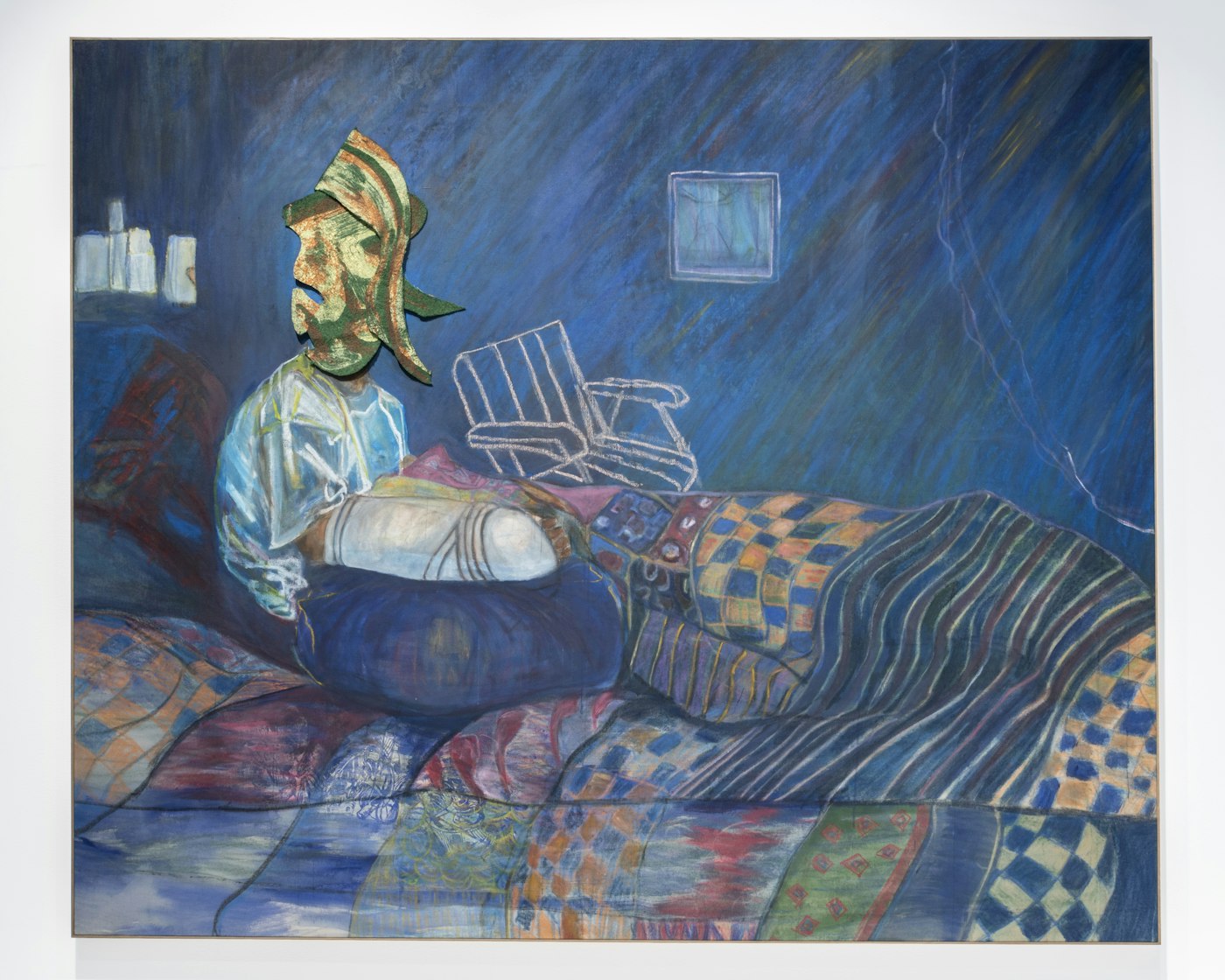
The exhibition Älskad // Treasured presents a suite of new paintings in oil and drawings in charcoal, on canvas, that revolve around a single attempt — to extract stories from Kayo Mpoyi’s family photo album — specifically belonging to her mother. By returning to the photographs and to what can only be seen, but not heard, the artist investigates how memories can be broken apart, reshaped and reassembled. Each work moves in a borderland between clarity and recognition, toward abstraction and emotional weight. Between the state of finished and unfinished.
The artist describes the work Bror, 2026 (Brother, 2026) as a process of different methods in which the painting’s visual expression and form underwent several iterations. A face that refused to be depicted, which again and again moved away from the artist’s own idea, and direction. When the earthy tones of paint are finally applied, figuration in the image is swallowed. Chair legs disappear, details are blurred and a new stillness emerges. Layer upon layer leading to both reduction and a sense of completion. The painting began with a drawing in charcoal and through the artist’s intention was born and made understood in paint. This shift between charcoal and paint remains as a trace in several of her paintings.
For Kayo Mpoyi the process is central. Several works have been painted over multiple times, where earlier versions can only be glimpsed beneath the surface. In the work Vattnets fjärde fas, 2026 (The waters fourth phase, 2026) the woman’s clothing was scraped out in the final stage. A definite return to the paintings very first layer. The blackness of the charcoal is still visible in some areas, as if the image was in a state between envelopment and dissolution. In the work Lager av rekonstruktion, 2026 (Layers of Reconstruction, 2026) the characters have been moved around. One was lifted out. One has changed places. The artist’s investigative and exploratory actions contribute both to destruction and to cohesion. There is an eternal balancing act, tested and disciplined by Mpoyi’s hands and brushstrokes. Kayo directs the viewer’s gaze toward the character’s finger, just as she does in the painting, staging the very gestures she applies herself. Gestures that carry the story, rather than describe it.
In her return to her mother’s photo-album, the artist places herself in a contemporary painterly tradition where the photograph functions as both point of departure and resistance. As in Luc Tuymans’s oeuvre, there is a deliberate shift between the original’s clarity and the painting’s uncertainty. The photographic motif is broken down through the reduction of color via a palette that leans toward earthy and muted tones. Memory does not appear as a fixed image, but as something filtered, diluted and yet, charged with emotional weight. At the same time Mpoyi shares an affinity with the artist Njideka Akunyili Crosby in the use of the family archive as living material. Where Crosby merges private photographs and painting into complex pictorial spaces, Mpoyi lets her figures emerge from layers of charcoal and oil. The archive does not become a nostalgic recolection, instead a place for renegotiation; a room where identity, displacement and belonging can be reconstructed through the act of painting.
In several works a state of stillness arises that recalls artist Lynette Yiadom-Boakye, whose figures inhabit a timeless in-between. In Mpoyi’s work the figures are partially freed from the specific photographic situation and step into a more universal emotional field where the gaze, the hand, the tilt of the body are gestures that become vital to the story, rather than photographic documentation or replica.
In the paintings’ interiors the kitchen, the chair and the living room are visible throughout, and through these objects an iconography of care and reverence is formed. The everyday room becomes a place of restoration and quiet freedom. Here traditional narratives of power and history are displaced in favor of intimacy and closeness. Care does not appear as sentimentality, however as method: in the overpainting and scraping, in the contrary return to the face that refuses to be finalised.
The exhibition title Treasured functions as a prayer or an incantation. Mpoyi describes how working with the archives of photographs and all the memories evoke a fundamental sense of love. Love for those depicted, for their stories as well as for the very act of painting. It is an attempt to come to terms with what has been, to heal the cracks and hold together what risks falling apart. The title becomes an affirmation, manifestation — I am treasured, we are treasured. In this mantra, between vulnerability and strength, the paintings and the practice of painting become a space for restoration and care. Together the works form a visual weave of layers and memories. The paintings make the attempt to stitch parts of a narrative into a whole, while also accepting that some threads are loose and traces have been erased.
Kayo Mpoyi was born in 1986 in Congo-Kinshasa, DRC and grew up in Stockholm, Sweden. She is a published author of the books Kitoko, An Exercise in Revolution and Mai Means Water. Mpoyi received an MFA from the Royal Institute of Art in Stockholm (2025).
She has been presented in several institutional group exhibitions, inclduing: Stockholm Cosmologies, Liljevalchs, 2025; The Great Noise, Västernorrland Triennial, 2025; The Royal Academy of Fine Arts, 2025; Family — For Better and Worse, Sven-Harry’s Art Museum, 2026. Kayo Mpoyi was selected for Grafikens Hus art residency 2025 where she presented a solo exhibition of prints and a large scale installation.
The exhibition Älskad // Treasured is her first exhibition at Saskia Neuman Gallery.
ARTWORK


PRESS
18.03.2026
Dagens Nyheter ↗Magnus Bons
01.04.2026
Dagens Nyheter ↗Aron Hedlund Sturk
02.04.2026
Konsten.net ↗Joanna Persman
02.04.2026
Dagens Nyheter ↗Birgitta Rubin