The Chamber of Graphs, Charts & Timelines
Mark Dion (born August 28, 1961) is an American conceptual artist best known for his use of scientific presentations in his installations. Throughout his artistic practice, Dion has examined the ways in which dominant ideologies and public institutions shape our understanding of history, knowledge, and the natural world. His work consistently interrogates how institutions — whether natural history museums, universities, or economic bodies — construct and legitimize knowledge. Known for investigating how knowledge is produced, organized, displayed, and maintained — especially through systems of museums, natural history, and scientific inquiry — Dion often employs structures of varying sizes; relaying on art historical displays such as cabinets of curiosity to large-scale archaeological digs, field stations, and even faux scientific displays to question authority, methods of classification, and the human impact on eco-systems, as well as the narratives embedded in collecting bodies such as institutional collections.
By appropriating archaeology, field ecology, and other scientific methods of collecting, ordering, and exhibiting objects, the artist questions the objectivity and authoritative role of the scientific voice in contemporary society. Tracking how pseudo-science, social agendas, and ideology creep into public discourse and knowledge production, his work examines the manner in which prevalent ideologies and institutions influence our understanding of history, knowledge, and the natural world. The job of the artist, according to him, is to ‘go against the grain of dominant culture, to challenge perception and convention.’
Mark Dion creates elaborate sculptural installations, oftentimes including performative elements, through which he investigates how those systems of classification, display, exploration, and preservation inform the construction of knowledge, especially where it involves the natural world. More concerned with how knowledge about nature is ideologically driven than with nature itself, Dion explores the ways in which institutions assist, and sometimes hinder, our understanding of the natural world and our position within it, questioning the authority of those institutions and their conventions. Along with his interest in the capacity for objects to tell us something about the world, his commitment to the scientific method and connection to the environment, both flora and fauna, form the foundation of his multivalent practice, within which he adopts many of the same conventions that he challenges.
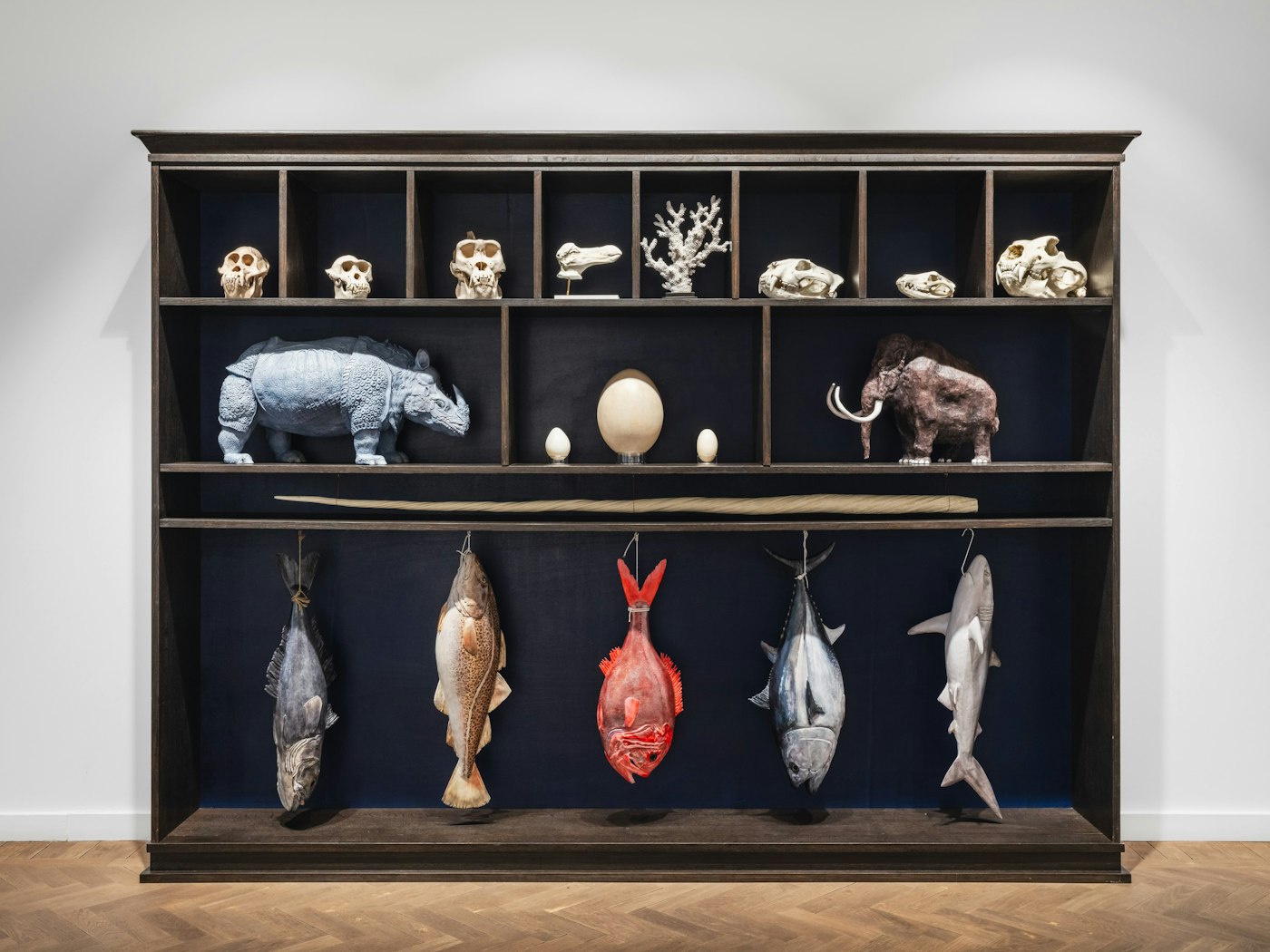
Dion’s second solo exhibition at the gallery, The Chamber of Graphs, Charts & Timelines, introduces a suite of thirty new drawings, playfully expressing a myriad of themes, including politics; the current state of the world; literature; art history; sciences along with references to the old testament. In addition to the drawings, the exhibition also introduces two important sculptures by the artist, The Extinction Cabinet, 2021 and The Salmon of Knowledge, 2015 — the latter has never been shown in the region. The Extinction Cabinet was exhibited at Akvarell Museet in Sweden in 2023 and relies heavily on sculptural elements depicting animals and material that has become extinct or is at risk of doing so. The various sculptures and components presented in the wooden cabinet are composed out of resin and plaster, allowing for an impression of both real artifact and whimsical distortion of natural elements. The Salmon of Knowledge is introduced as a counter part to the cabinet: the sculpture turns scale and color into a material study, presented in bronze, steel, wood, foam, paper, aerosol enamel, acrylic paints, adhesives, glass eyes, wire, and mixed media. It offers a condensed and serious introduction to the power of representation of the natural world and sciences, where the salmon rests stoutly on top of piles of matter, most recognizable elements from our everyday lives, entrenched in tar.
The use of tar, the nod to petroleum culture, is something the artist has used avidly in his work since 1988. In The Salmon of Knowledge, Dion creates a clear link between the mythological story of The Salmon of Knowledge and the very real present dangers that exist in current global society. The Celtic myth of The Salmon of Knowledge is the story of a king, a salmon that lived in a well that is situated underneath The Tree of Knowledge. According to the myth; hazelnuts from the tree would fall into the well, the salmon ate the hazelnuts, thus gaining the tree’s knowledge. After many attempts the king finally manages to capture and kill the salmon, asking a young boy who works at the court to prepare the salmon. The king plans to eat the salmon and become all-knowing. The boy touches the fish to see if it is ready, then licks his finger, tasting the fish, subsequently becoming filled with all of the salmon’s knowledge. The king immediately knows what has transpired and sees to it that the boy becomes his most prised and trusted advisor.
For the artist, salmon culture is inherent in how we function and communicate in western society; several western myths find their foundation in salmon culture, and many European cities are built on the site of salmon runs. Salmon runs are places where salmon was found in the waterways in abundance. As salmon was and is seen as incredibly valuable, perhaps one of the most valuable and healthy wild foodstuffs, packed with nutrients. The myth of The Salmon of Knowledge also acts as a warning of what happens when acts of greed fuel our actions, killing the heroic and wise salmon for personal gain, essentially killing the ‘golden goose’. These types of myths and stories exist throughout western storytelling culture and can be found in North America, as well as Europe.
Throughout the exhibition Dion’s drawings take a very playful approach to incredibly serious subjects: levity is key. According to the artist, ‘humor is the one tool in the toolbox of the more middle-minded people that ultra-conservatives don’t have’. The drawings arrest the viewer; to see them, the viewer must look closely. The artist's ambition is to capture the viewer for longer than often spent looking at a work mounted on the wall. The drawings and print work create intricate parodies of systems of knowledge; and as these systems are ones we can’t fully trust anymore, or at least in our current climate of information, the idea that knowledge becomes tenuous resurfaces. Dion’s drawings become inoculations against fake news, through a very playful and mischievous lens.
ARTWORK


PRESS
23.04.2026
Monopol Magazin ↗Vera Görgen
29.04.2026
Dagens Nyheter ↗Birgitta Rubin